Skip to content
synovial sarcoma foundation
  • About
    • Mission
    • Initiatives
    • Affiliations
    • Leadership
    • Board of Directors
    • Careers
  • Resources
    • Synovial Sarcoma FAQ
    • Treatments
    • Clinical Trials & Therapies
    • Synovial Sarcoma Patient Survey
    • Synovial Sarcoma Tumor Board
    • Patient Stories
    • Patient Resources
    • Eddie’s Story
  • Research Programs
    • Clinical Research
    • Tumor Glow
    • Synovial Sarcoma Registry
  • Latest News
Donate

Send us a note

Please fill out the form below and we will gladly respond as soon as possible.

    Research, Education, Synovial Sarcoma Registry

    Rise in Early-Onset Cancers: More Diagnoses, Not Always More Disease

    October 3, 2025 nathani Comments Off on Rise in Early-Onset Cancers: More Diagnoses, Not Always More Disease
    Three medical professionals walk and talk in a bright hallway. One wears a white coat with a stethoscope, while the others wear scrubs. Two more people in white coats are visible on the stairs in the background.

    Headlines about cancer appearing in younger adults have sparked concern: are cancers truly rising in people under 50? A new study published in JAMA Internal Medicine suggests the story is more complicated — and in many cases, less alarming.

    What the Study Found

    Researchers from Brigham and Women’s Hospital reviewed incidence and mortality data for eight cancers that have shown the fastest rise in adults under 50 since 1992: thyroid, anal, kidney, small intestine, colorectal, endometrial, pancreatic, and myeloma.

    • Incidence doubled across these cancers over three decades.
    • Mortality stayed flat overall.
    • Only colorectal and endometrial cancers showed a modest increase in deaths.

    This pattern — more diagnoses without more deaths — points to what experts call overdiagnosis: detecting cancers that may never cause harm. For thyroid and kidney cancers, especially, improved imaging and screening often reveal small lesions that remain indolent.

    Why It Matters for Patients

    The findings highlight a critical nuance: not every detected cancer is clinically meaningful. For younger patients, especially, this can mean confronting a diagnosis that may never progress but still carries psychological and treatment burdens.

    Patients should keep in mind:

    • Colorectal cancer shows both rising incidence and mortality; this is a genuine concern and supports current efforts to lower screening ages.
    • Endometrial cancer is also trending upward, likely tied to obesity and declining hysterectomy rates.
    • Other cancers in this group (thyroid, kidney, small intestine, pancreas, myeloma, anal) show flat or declining mortality despite more diagnoses — a sign that detection practices may be driving the numbers more than biology.

    What Doctors Are Saying

    Editorialists from Yale School of Medicine emphasized that mortality, not just incidence, should guide cancer policy and prevention efforts. Detecting more cancer is not the same as saving lives — what matters is reducing morbidity and death.

    They argue for more refined screening and diagnosis strategies that distinguish between cancers requiring intervention and those not.

    Implications for the Synovial Sarcoma Community

    While synovial sarcoma was not part of this analysis, the study offers important lessons:

    • Context matters. Rising case numbers should always be interpreted alongside mortality and outcomes.
    • Overdiagnosis risk differs by cancer type. For rare cancers like synovial sarcoma, underdiagnosis and misdiagnosis remain a greater challenge than overdiagnosis.
    • Screening strategies must be nuanced. Broad screening may inflate incidence in some cancers while leaving rare and aggressive cancers underdetected.

    How SSF Is Driving Answers

    Better understanding, earlier recognition, and more effective treatment strategies are urgently needed for synovial sarcoma. That’s why the Synovial Sarcoma Foundation has invested in a national clinical registry and biospecimen repository, housed at CHOP and Penn Medicine. By gathering patient-reported data and tumor samples, we are building the evidence base to answer the hard questions about this rare cancer — from diagnosis to treatment.

    We encourage all patients and families affected by synovial sarcoma to participate. Adding your information strengthens the research community and accelerates progress. Learn more and join here.

    The Takeaway

    The “epidemic” of early-onset cancers may be less about an explosion of disease and more about how medicine now detects it. For patients, the key is not to fear every statistic but to ask clear questions:

    • Is this diagnosis likely to become clinically meaningful?
    • What does my stage, grade, and tumor biology say about my risk?
    • What are the options for surveillance vs treatment?

    As the authors note, the real challenge for cancer care in the next decade will not be simply finding more cancers — it will be finding and treating the cancers that truly matter.


    nathani

    Post navigation

    Previous
    Next

    Search

    Categories

    • Black Flag Racing (2)
    • Children (1)
    • CHOP (3)
    • Development (9)
    • Dr. Theodore Laetsch (3)
    • Education (16)
    • Healthcare (9)
    • Latest News (8)
    • Programs (1)
    • Rare Cancer (5)
    • Rare Cancer Funding (1)
    • Research (17)
    • Synovial Sarcoma Conference (2)
    • Synovial Sarcoma Registry (3)
    • Teresa Belluco (1)
    • Tumor Board (2)

    Recent posts

    • A person wearing protective goggles, face mask, and gloves examines two small glass vials containing yellow and orange liquids in a laboratory setting.
      Synovial Sarcoma Research and Rare Cancer Drug Development: Challenges and Progress
    • A scientist wearing safety goggles and gloves examines samples through a microscope in a bright laboratory, with other researchers working in the background.
      New Research Identifies 4 Subtypes of Synovial Sarcoma, Opening Doors for Personalized Treatment
    • A scientist in a lab coat and gloves uses a pipette to add liquid to a test tube. Several test tubes filled with blue liquid are in a rack beside a microscope on a bright laboratory desk.
      What a Breakthrough in Ewing Sarcoma Means for Synovial Sarcoma

    Tags

    Afami-cel biomarker testing synovial sarcoma BRAF mutated synovial sarcoma cancer innovation CHOP clinical trial clinical trials rare cancer immunotherapy new treatments for synovial sarcoma nonprofit drug development pediatric synovial sarcoma Rare Cancer rare cancer clinical trials rare cancer research rare disease drug development rare disease funding rare pediatric cancer rare soft tissue sarcoma research soft tissue cancer soft tissue sarcoma solitary fibrous tumor SS18-SSX fusion SS18-SSX translocation SS18::SSX SS research STAT6 marker SFT Synovial Sarcoma synovial sarcoma case report synovial sarcoma clinical trials synovial sarcoma diagnosis Synovial Sarcoma Foundation synovial sarcoma in children synovial sarcoma research synovial sarcoma subtypes synovial sarcoma symptoms synovial sarcoma treatment synovial sarcoma treatment market targeted cancer therapy targeted therapies for sarcoma targeted therapy TECELRA Tecelra T-cell therapy trabectedin webinar

    Related posts

    A doctor in a white coat with a stethoscope around their neck holds a tablet device, standing in a medical setting with a patient lying on a bed in the background.
    Education, Healthcare

    Rare Tumor Mimics Synovial Sarcoma: Why Accurate Diagnosis Matters

    April 17, 2026 ayushis Comments Off on Rare Tumor Mimics Synovial Sarcoma: Why Accurate Diagnosis Matters

    A recent case report highlights a rare GLI1-altered mesenchymal tumor presenting in the pleura (lining of the lung), a location where tumors can closely resemble synovial sarcoma. This case underscores a critical challenge in rare cancers — different tumors can appear similar under imaging and even under the microscope, making accurate diagnosis essential for appropriate […]

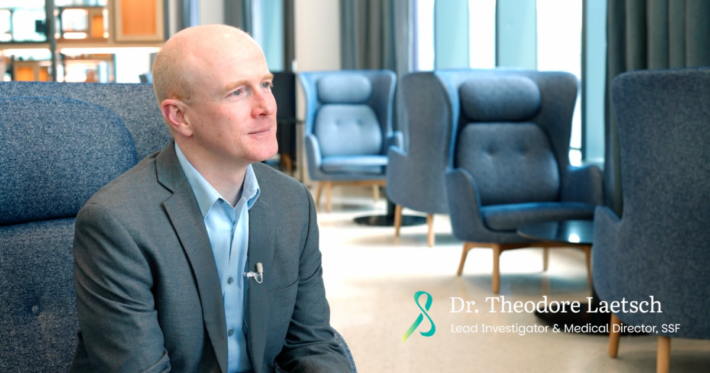
    A man in a gray suit sits in a modern, well-lit office lounge. Text on the image reads: "Dr. Theodore Laetsch, Lead Investigator & Medical Director, SSF." Blue chairs and large windows are in the background.
    CHOP, Dr. Theodore Laetsch

    Dr. Theodore W. Laetsch, Synovial Sarcoma Foundation Board Member, Receives $1 Million Grant to Advance Rare Tumor Studies

    September 29, 2025 joshs Comments Off on Dr. Theodore W. Laetsch, Synovial Sarcoma Foundation Board Member, Receives $1 Million Grant to Advance Rare Tumor Studies

    The Synovial Sarcoma Foundation is pleased to highlight a significant milestone at the Children’s Hospital of Philadelphia (CHOP), where pediatric oncologist and Synovial Sarcoma Foundation Board Member, Dr. Theodore W. Laetsch, has been awarded a prestigious $1 million multi-year grant from the National Cancer Institute (NCI). This funding aims to accelerate research and treatment development […]

    A smiling woman with glasses holds an award plaque in front of a backdrop featuring “CONQUER CANCER,” “RESEARCH CONQUERS CANCER,” and Synovial Sarcoma Foundation logos from The ASCO Foundation.
    CHOP, Development, Dr. Theodore Laetsch, Research

    Synovial Sarcoma Foundation Celebrates Groundbreaking Achievement by Rachel Dr. Hurly

    June 3, 2025 joshs Comments Off on Synovial Sarcoma Foundation Celebrates Groundbreaking Achievement by Rachel Dr. Hurly

    The Synovial Sarcoma Foundation is proud to announce a significant milestone in pediatric cancer research: Dr. Rachel Hurly, a dedicated pediatric oncology fellow from the Children’s Hospital of Philadelphia (CHOP), has been honored with the prestigious American Society of Clinical Oncology (ASCO) Young Investigator Award. Dr. Hurly conducts her research under the mentorship of Dr. Ted Laetsch at the Haldor Laboratory at the University of Pennsylvania, with support from the Synovial Sarcoma Fund.

    The Synovial Sarcoma Foundation is a registered 501(c)(3) nonprofit organization. Tax ID number is 33-4027591. Contributions to the Synovial Sarcoma Foundation are tax-deductible to the extent permitted by law.

    • Terms & conditions
    • Privacy policy
    synovial sarcoma foundation
    • community@synovialsarcoma.org
    1025 Thomas Jefferson St. NW, Suite W-3200, Washington DC 20007
    Facebook-f X-twitter Linkedin

    Navigation

    • About
    • Research Programs
    • Patient Stories
    • Resources

    Stay in touch