Resources & Support
Find answers to common questions about synovial sarcoma and learn how we're advancing the fight for a cure.
Synovial Sarcoma FAQs
A synovial sarcoma diagnosis often comes with more questions than answers. Because this cancer is rare, understanding what it is, how it's diagnosed, and what treatment may involve can be difficult to piece together. The FAQs below cover the essentials patients and families most often ask about, from diagnosis through treatment planning.
Synovial sarcoma is a rare and aggressive cancer originating primarily in deeper soft tissues such as muscles, tendons, ligaments, and fibrous connective tissue, typically close to joints. Despite its name, synovial sarcoma does not originate in synovial tissue which is the specialized lining found inside joints. Instead, it received its name because cancer cells closely resemble synovial cells under a microscope.
This cancer is most frequently diagnosed in adolescents and young adults but can occur at any age. It accounts for approximately 5–10% of all soft tissue sarcomas.
Synovial sarcoma is classified as an orphan disease, indicating that it is exceptionally rare, historically receiving limited research funding and medical attention. Due to its rarity, it has posed significant challenges for accurate diagnosis, treatment advancement, and patient support. The Synovial Sarcoma Foundation aims to bridge these gaps by promoting research, awareness, and improved medical outcomes.
Synovial sarcoma can occur virtually anywhere in the body but most often develops in soft tissues near large joints. According to a comprehensive patient survey conducted by the Synovial Sarcoma Foundation involving over 200 respondents:
- Legs (32%) – especially near the knee and thigh.
- Chest (17%) – often within the thoracic cavity, lungs, or chest wall.
Other frequent locations include:
- Arms: especially near the elbows, wrists, or forearms.
- Ankles and feet: often appearing as a lump or swelling.
- Hips and pelvis: near major joints or muscles.
- Shoulders: typically around or just below the joint.
Though less common, synovial sarcoma can also develop internally in areas such as the abdomen, heart, or head and neck regions, making diagnosis more challenging.
Synovial sarcoma is rare but most frequently diagnosed in younger individuals, typically between the ages of 15 and 40. Approximately one-third of cases are diagnosed in individuals under age 30. It occurs slightly more often in males than females, though individuals of all genders and ethnicities can be affected.
This type of sarcoma is exceptionally uncommon, accounting for approximately 5% to 10% of all soft tissue sarcomas. Soft tissue sarcomas themselves make up less than 1% of all cancers, meaning synovial sarcoma is incredibly rare, occurring in just 1 to 2 individuals per million annually.
The exact cause of synovial sarcoma remains unknown, but researchers have identified that it is driven by a genetic mutation. This mutation occurs when parts of two genes—SS18 (formerly called SYT) and SSX1, SSX2, or less commonly, SSX4—fuse together. This fusion produces an abnormal protein that disrupts normal cellular function, leading to uncontrolled cell growth and tumor formation.
While we know the genetic mechanism behind synovial sarcoma, the factors that cause this mutation to occur in the first place remain unclear. Scientists have studied several possibilities, but no definitive environmental, lifestyle, or inherited genetic causes have been identified:
Not Typically Inherited: Synovial sarcoma is not considered hereditary, meaning it does not typically run in families. The SS18-SSX fusion mutation arises spontaneously in affected cells rather than being passed down genetically (Dana-Farber Cancer Institute).
Environmental Factors: There is no conclusive evidence linking synovial sarcoma to environmental exposures such as radiation, toxins, or chemicals. However, researchers continue to explore whether certain exposures could play a role in increasing the risk.
Random Cellular Events: Like many cancers, synovial sarcoma may result from random errors during cell division. Occasionally, normal cellular processes can go awry, leading to mutations like the SS18-SSX fusion.
Potential Influences of Age and Development: Synovial sarcoma is most frequently diagnosed in adolescents and young adults, suggesting a possible link to rapid cellular growth or developmental processes during these life stages. However, this remains an area of active research.
No Established Risk Factors: Unlike some cancers, synovial sarcoma does not have well-known risk factors, such as smoking or a family history of related conditions. This makes predicting or preventing the disease particularly challenging.
Synovial sarcoma can be divided into three main types based on cellular appearance under the microscope. Identifying the specific type of synovial sarcoma helps doctors predict the tumor’s behavior and guide appropriate treatment decisions.
Monophasic Synovial Sarcoma: The most common type, comprising about 60% to 70% of cases. These tumors primarily contain spindle-shaped cells, closely resembling fibrous or connective tissue.
Biphasic Synovial Sarcoma: Making up around 20% to 30% of cases, biphasic tumors include two distinct cell types: spindle-shaped cells and epithelial-like cells, which have a rounded, glandular appearance.
Poorly Differentiated Synovial Sarcoma: The rarest and most aggressive form, accounting for approximately 10% of cases. These tumors have cells that appear highly abnormal and lack clear structural organization, which makes them more likely to spread rapidly.
Diagnosing synovial sarcoma requires a combination of imaging, biopsy, and increasingly, advanced genetic testing. These methods confirm the diagnosis, assess the tumor’s characteristics, and guide treatment decisions.
Imaging Tests
Imaging scans help doctors assess the size, location, and spread of the tumor.
- MRI (Magnetic Resonance Imaging)
- Ideal for visualizing soft tissue tumors.
- Provides high-resolution images to determine if the tumor is invading surrounding tissues.
- CT (Computed Tomography) Scans
- Often used to detect metastasis, particularly in the lungs (American Cancer Society).
- Helps doctors plan surgical and treatment approaches.
- PET (Positron Emission Tomography) Scans
- Detects cancer activity throughout the body.
- Helps identify areas of metastasis and monitor treatment effectiveness.
Biopsy
A biopsy is necessary to confirm the presence of synovial sarcoma. The defining genetic marker of this cancer is the SS18-SSX fusion gene, found in nearly all cases.
- Core Needle Biopsy - A minimally invasive procedure that removes a small tissue sample for analysis.
- Surgical Biopsy - A larger tissue sample is extracted for more detailed examination.
Because synovial sarcoma can resemble other soft tissue tumors, biopsy samples should be analyzed by a specialized sarcoma pathology lab.
Advanced Genetic & Molecular Testing
Genetic and molecular testing plays an increasingly vital role in diagnosing synovial sarcoma, particularly for cases where imaging and biopsy findings are inconclusive. These tests analyze the tumor’s genetic makeup, providing precise confirmation of the disease and identifying potential treatment targets.
- Fluorescence In Situ Hybridization (FISH):
- Detects the SS18-SSX fusion gene, the hallmark of synovial sarcoma.
- Uses fluorescent DNA probes to confirm the genetic sequences, allowing pathologists to visually confirm the presence of the chromosomal translocation under a microscope.
- A highly specific and rapid diagnostic tool, making it one of the most widely used methods for diagnosing synovial sarcoma.
Reverse Transcription Polymerase Chain Reaction (RT-PCR):
- Identifies the exact fusion transcript from the the SS18-SSX gene rearrangement.
- Highly sensitive and often used alongside FISH for added confirmation.
Next-Generation Sequencing (NGS):
- Provides a comprehensive genetic profile of the tumor.
- Identifies additional genetic alterations that could guide personalized treatment decisions, such as targeted therapy or immunotherapy.
- Some clinical trials require NGS results to determine eligibility for experimental treatments.
Treatments
Because synovial sarcoma is rare, patients should seek care at a major cancer center or an NCI-designated sarcoma specialist from the outset. These institutions have the necessary expertise, access to advanced diagnostic tools, and experience treating synovial sarcoma, ensuring that patients receive the most effective and up-to-date treatment options available. A multidisciplinary team of specialists, including surgical oncologists, medical oncologists, and radiation oncologists, will develop a personalized treatment plan based on the patient's specific case.
Synovial sarcoma treatment is typically managed by a multidisciplinary team of specialists, including specialized surgeons, surgical oncologists, medical oncologists, and radiation oncologists. Standard treatment approaches include:
Surgery is the cornerstone of treatment for synovial sarcoma and is aimed at completely removing the tumor with clear margins. Achieving clear margins (no cancer cells at the edges of the removed tissue) is critical to reducing the risk of recurrence. In some cases, amputation may be necessary if the tumor cannot be fully removed while preserving the affected limb. Advances in surgical techniques have improved the ability to remove tumors while preserving function.
Radiation therapy is frequently used before or after surgery to target cancer cells that may remain in the area. Pre-surgical radiation (neoadjuvant) can shrink the tumor, making it easier to remove, while post-surgical radiation (adjuvant) is often used to treat the tumor bed, reducing the risk of recurrence by targeting microscopic cancer cells that may remain after surgery.
Advanced techniques, such as intensity-modulated radiation therapy (IMRT) and proton radiation therapy, allow precise targeting of the tumor while minimizing damage to surrounding healthy tissue. Proton radiation therapy, in particular, delivers high doses of radiation directly to the tumor or tumor bed, while significantly reducing exposure to nearby organs and critical structures. This makes it especially beneficial in treating tumors located near sensitive areas like the lungs, heart, or chest wall.
Chemotherapy is a key component of synovial sarcoma treatment, particularly for high-grade tumors, advanced cases, or when metastasis is present. It is often used to shrink tumors before surgery (neoadjuvant therapy), to eliminate remaining cancer cells after surgery (adjuvant therapy), or to manage metastatic disease. While doxorubicin (Adriamycin) and ifosfamide remain the first-line chemotherapy regimen, several other drugs and targeted therapies are also used based on the individual patient's condition and response to treatment.
Doxorubicin (Adriamycin) + Ifosfamide: This combination is the most widely used first-line chemotherapy for synovial sarcoma. It has shown effectiveness in shrinking tumors and improving progression-free survival in certain patient populations. It is typically administered in cycles, either alone or combined with other drugs, depending on the patient's tolerance and disease stage.
For patients whose cancer does not respond to first-line chemotherapy or who experience recurrence, additional chemotherapy drugs may be considered:
Trabectedin (Yondelis): Approved for soft tissue sarcomas, this drug works by damaging DNA in cancer cells, leading to tumor suppression. It is particularly useful in patients who have progressed on prior treatments.
Gemcitabine (Gemzar) + Docetaxel (Taxotere): This combination is commonly used for various soft tissue sarcomas, including synovial sarcoma, especially in patients who do not respond to doxorubicin-based treatments.
Eribulin (Halaven): Originally developed for breast cancer, this drug has shown activity in certain subtypes of soft tissue sarcoma and may be considered in select cases.
For patients with advanced or metastatic disease, targeted therapies and immunotherapies are becoming increasingly important.
Pazopanib (Votrient): An FDA-approved targeted therapy for advanced soft tissue sarcomas, including synovial sarcoma, Pazopanib works by blocking tumor blood vessel formation (angiogenesis) and tumor growth. It is typically used in patients who have already received prior chemotherapy.
Afamitresgene Autoleucel (Tecelra): A newly approved T cell receptor gene therapy (FDA-approved in 2024) for unresectable or metastatic synovial sarcoma in patients who have received previous chemotherapy. This personalized immunotherapy modifies a patient’s own immune cells to target and destroy cancer cells expressing the MAGE-A4 antigen, a marker found in many synovial sarcomas.
Ongoing research and clinical trials are expanding treatment options for synovial sarcoma. Next-generation sequencing (NGS) and genetic profiling are helping doctors identify individualized treatment approaches, including experimental therapies and clinical trial enrollment.
Patients diagnosed with synovial sarcoma should seek care at a major cancer center with sarcoma specialists to ensure access to the latest treatments and expert guidance on therapy selection.
Clinical trials offer access to cutting-edge treatments, including immunotherapies, targeted therapies, and novel drug combinations. Targeted therapies focus on specific genetic changes, such as the SS18-SSX fusion gene, which drives synovial sarcoma. For example, drugs like pazopanib (a tyrosine kinase inhibitor) have shown promise in treating advanced or metastatic sarcomas.
Participation in clinical trials can be an important option for patients, especially when standard treatments are not effective.
Get Started
Know What to Ask, Know What's Next
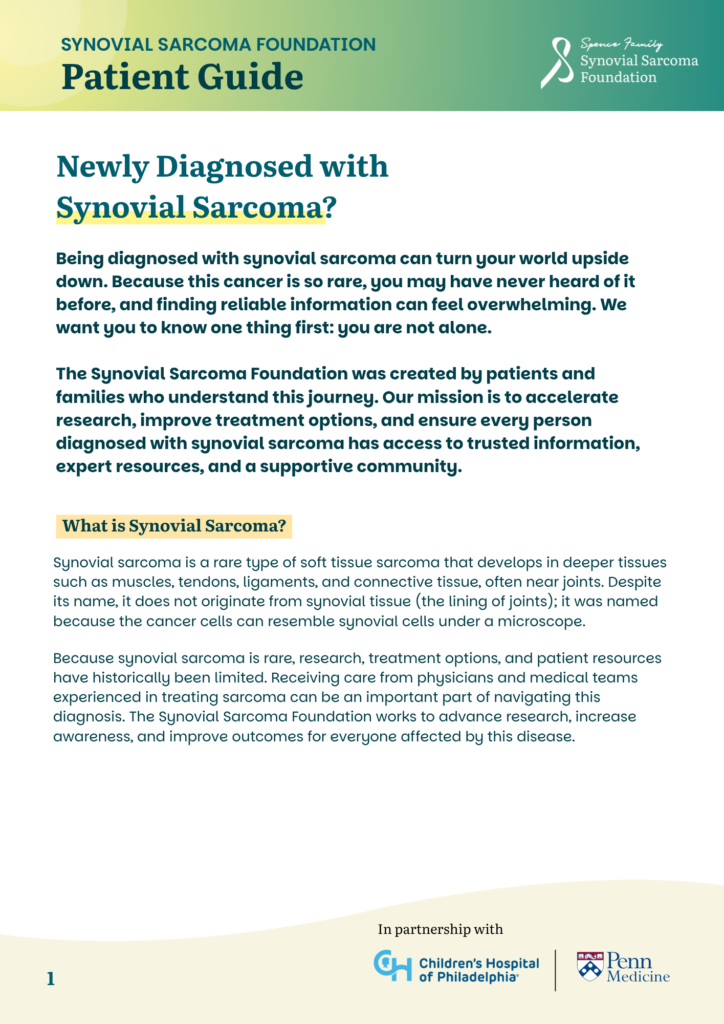
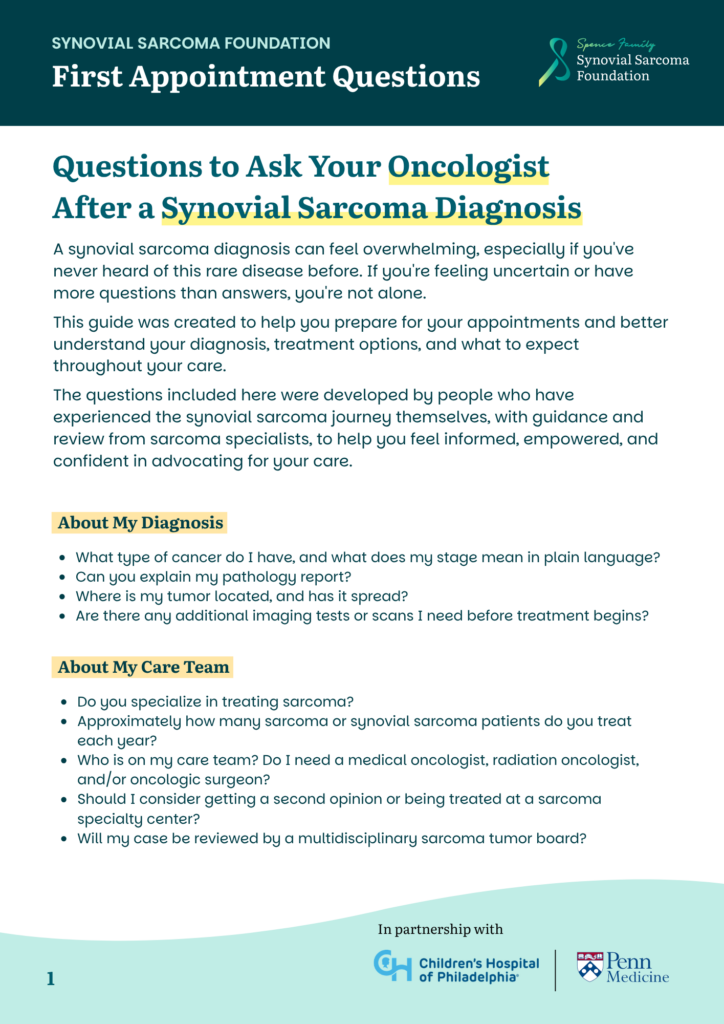
Being newly diagnosed with synovial sarcoma can feel overwhelming. Our Patient Guide and First Appointment Questions were created by patients and families, with review from sarcoma specialists, to help you understand your diagnosis, prepare for your care team, and feel confident advocating for yourself. View them online or print them to bring to your next appointment.
Support
Find Strength in Community
The Synovial Sarcoma Facebook Community is a supportive space for patients, families, and caregivers to connect, share experiences, and stay informed about the latest treatments and research.
Our goal is to provide emotional support, foster collaboration, and ensure no one faces Synovial Sarcoma alone. Together, we can drive progress through shared knowledge and collective strength.
Health Information Disclaimer
The content provided on this website is for informational purposes only and should not be considered medical advice. The Spence Family Synovial Sarcoma Foundation is a charitable organization, not a healthcare provider, and we do not diagnose, treat, or recommend specific medical care. All medical decisions, including participation in clinical trials or treatments, should be made in consultation with a licensed physician or qualified healthcare provider.
While we strive to ensure the accuracy of the information we share, medical research and guidelines are constantly evolving. We cannot guarantee that all information on this site is complete, up-to-date, or free from errors. We strongly encourage visitors to verify information through trusted medical sources or by consulting their healthcare providers.

Empowering Hope Through Stories
Explore powerful stories of patients, survivors, and families who have confronted this rare cancer with resilience.